Overview
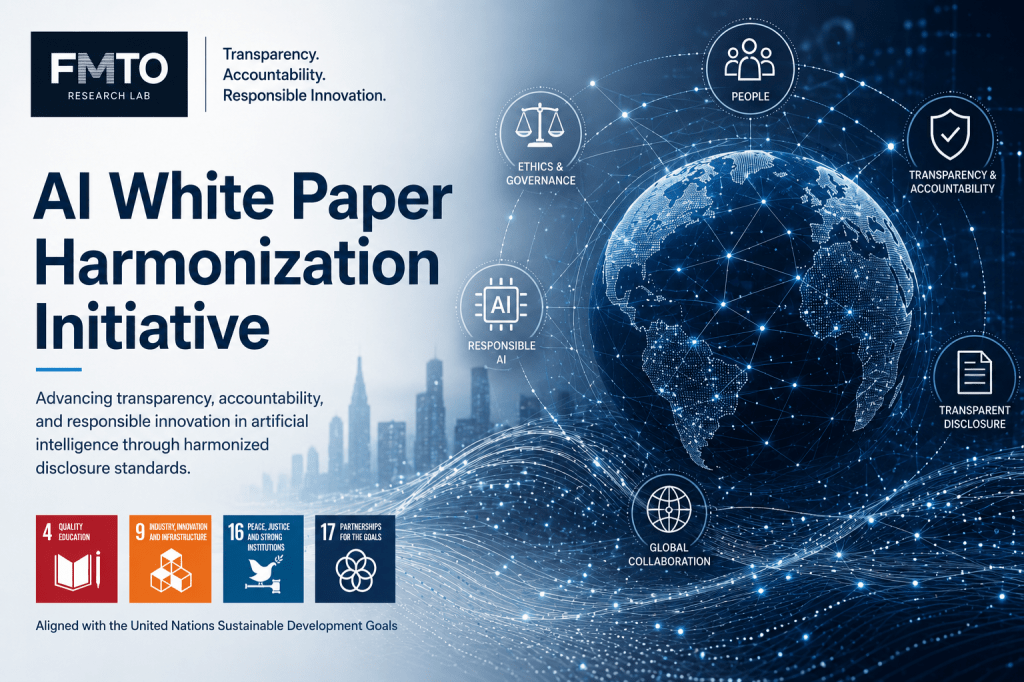
The AI White Paper Harmonization Initiative is a global research and policy project hosted by FMTO Research Lab. The initiative seeks to develop standardized disclosure frameworks for artificial intelligence projects by identifying common reporting practices, comparing them against academic, regulatory, and industry recommendations, and proposing harmonized disclosure standards that promote transparency, accountability, and responsible innovation.
Recognizing the limited availability of mature AI white paper corpora and established disclosure benchmarks, the initiative begins with a foundational blockchain research phase focused on Initial Coin Offering (ICO) white papers. This phase serves as a methodological testbed for developing corpus construction procedures, metadata frameworks, disclosure taxonomies, and harmonization techniques that will subsequently be extended to artificial intelligence projects.
The initiative, therefore, adopts a phased approach in which blockchain white paper harmonization provides the empirical and methodological foundation for the future development of harmonized AI white paper standards and broader emerging technology disclosure frameworks.
Vision
To advance transparency, accountability, and responsible innovation in artificial intelligence and emerging technologies through globally accessible disclosure standards and open knowledge.
Mission
To develop evidence-based white paper frameworks that improve transparency, comparability, governance, and stakeholder trust by identifying, analyzing, and harmonizing disclosure practices across blockchain and artificial intelligence projects.
Current Status
Status: Planned and Under Development
The initiative is currently in its foundational phase. The blockchain workstream builds upon ongoing doctoral research at UNICAF University focused on the harmonization of blockchain ICO white papers. The artificial intelligence workstream is scheduled for development between 2028 and 2030 through collaborative research, stakeholder engagement, and open-access knowledge sharing.
SMART Objectives
Objective 1
By December 2027, compile and publish an open-access corpus of at least 50 blockchain ICO white papers together with a standardized metadata repository containing a minimum of 20 descriptive variables for each project in order to establish a transparent and replicable foundation for blockchain disclosure research.
Objective 2
By December 2028, develop and publish a Blockchain White Paper Harmonization Framework and minimum disclosure checklist based on empirical corpus analysis, academic literature, regulatory guidance, and expert consultation to improve transparency, comparability, and governance within blockchain fundraising projects.
Objective 3
By June 2029, compile and document an open-access corpus of at least 50 artificial intelligence project white papers using a standardized metadata framework to support the systematic analysis of transparency, accountability, and governance disclosures in AI initiatives.
Objective 4
By September 2030, develop and publish an AI White Paper Harmonization Framework informed by empirical findings, stakeholder consultation, and best-practice recommendations in order to promote responsible innovation and trustworthy AI governance.
Objective 5
By December 2030, integrate the blockchain and AI frameworks into a Unified Emerging Technology Transparency Framework and publish all associated datasets, metadata codebooks, disclosure checklists, and supporting resources through an open-access repository maintained by FMTO Research Lab.
Scope
The initiative focuses on the development of transparency and disclosure frameworks for artificial intelligence projects through a phased research approach.
The current phase concentrates on blockchain ICO white papers and token-generation event documentation as a foundational research corpus for developing and validating harmonization methodologies. Subsequent phases will focus on artificial intelligence white papers, AI governance documentation, transparency reports, and related disclosure mechanisms.
Areas of interest include:
- Blockchain ICO white papers
- Blockchain token-generation event documentation
- Artificial intelligence project white papers
- AI governance and transparency documentation
- Technology disclosure frameworks
- Digital governance and accountability mechanisms
- Responsible innovation and transparency standards
The initiative does not evaluate investment performance, token prices, or financial returns, nor does it provide investment recommendations.
Stakeholders
The initiative seeks engagement from:
- Academic researchers
- Universities
- Doctoral students
- Industry practitioners
- Blockchain developers
- Artificial intelligence developers
- Policymakers
- International organizations
- Regulatory agencies
- Journal editors
- Civil society organizations
- Research institutes
- Think tanks
- Standards-setting organizations
Professional Affiliations
The initiative currently benefits from contributions by researchers and professionals affiliated with:
- Tecnológico de Monterrey
- EGADE Business School
- Smart Law & Business Review
- Council on International Law and Politics (CILP)
- Indiana University Robert H. McKinney School of Law
- UNICAF University
Roadmap
Phase I: Blockchain White Paper Harmonization (2026–2028)
- Build corpus of major ICO white papers
- Develop metadata framework
- Identify recurring disclosure elements
- Conduct expert validation
- Publish Blockchain White Paper Harmonization Framework
Phase II: AI White Paper Harmonization (2028–2030)
- Build corpus of AI project white papers
- Analyze transparency and governance disclosures
- Conduct stakeholder consultations
- Develop AI White Paper Harmonization Framework
Phase III: Unified Framework (2030)
- Integrate blockchain and AI findings
- Publish the Unified Emerging Technology Transparency Framework
- Release open-access repository
- Promote adoption through academic and policy engagement
United Nations Sustainable Development Goals Alignment
The initiative contributes primarily to:
SDG 4 – Quality Education
Promoting open knowledge, research transparency, and educational resources.
SDG 9 – Industry, Innovation and Infrastructure
Supporting responsible innovation and technology governance.
SDG 16 – Peace, Justice and Strong Institutions
Enhancing transparency, accountability, disclosure, and trust.
SDG 17 – Partnerships for the Goals
Encouraging collaboration among academia, industry, policymakers, and international organizations.
Participation
Researchers, institutions, students, practitioners, and organizations interested in transparency, governance, blockchain, and artificial intelligence are invited to participate in the initiative.
For collaboration inquiries, please visit the Contact page.


